Category
Category: Philosophy and theology
-
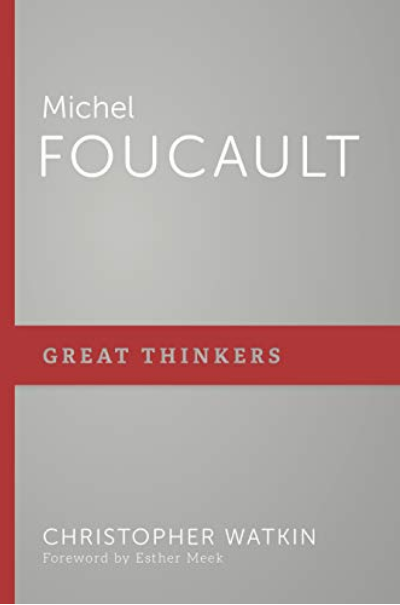
Summary and reviews of the book “Great thinkers: Michel Foucault”
Phillipsburg, NJ: P&R Press, 2018 Publisher’s Summary Hugely influential, Michel Foucault’s work has not only impacted a diverse range of disciplines—from history and sociology to fine arts, feminism, and gay and lesbian studies—but has also profoundly shaped Western culture at a street level. Yet until now there has been no overarching systematic approach to
-
Thinking Through Sin: Genesis 3, Sartre, and the power of the gaze
When Adam and Eve eat the fruit from the tree of the knowledge of good and evil their relationship undergoes a striking change. They begin accusing each other of wrongdoing (3:12-13), becoming ashamed (3:7,10) and being defensive (3:12-13). Their relationship becomes a zero sum game of power and domination (3:16b) in which each is
-
Explaining Derrida with Diagrams 1: Différance
I’ve written a book on Derrida which is intended to be accessible to non-philosophers, and one of the challenges is to explain Derrida’s thought both faithfully and clearly. I have decided to use diagrams as one way of helping readers to grasp what Derrida is saying and, equally importantly, what he isn’t saying. I am
-
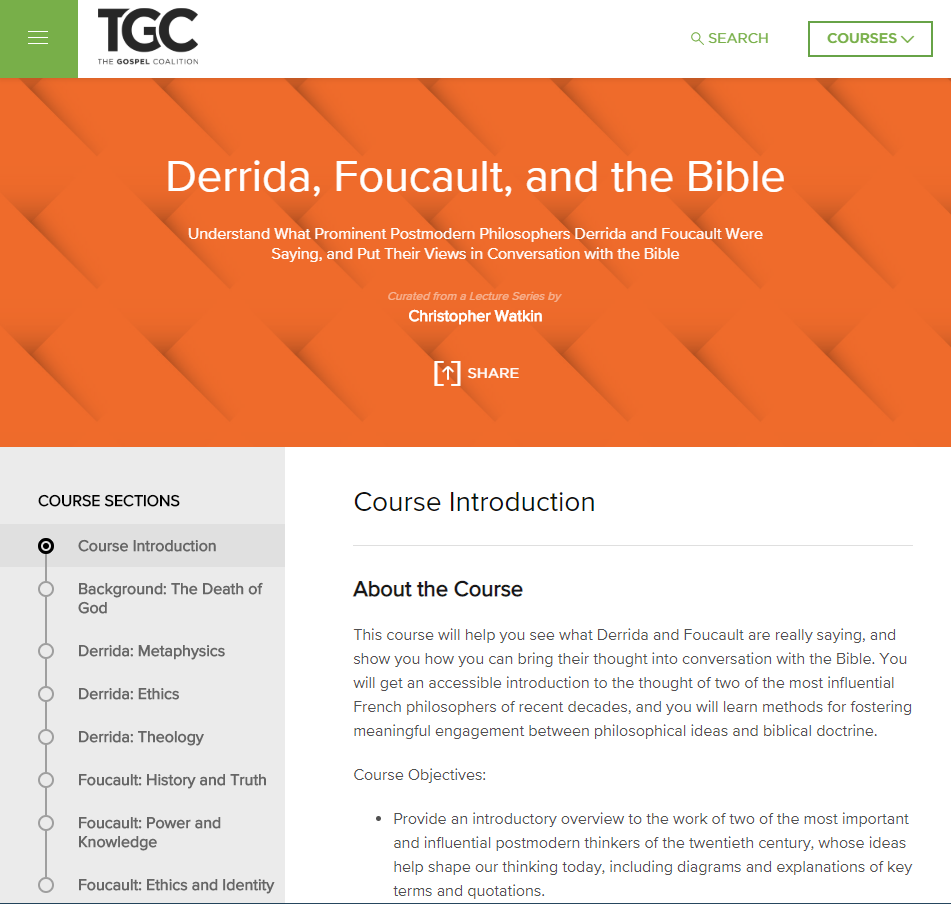
The Gospel Coalition Course | Derrida, Foucault, and the Bible
Derrida, Foucault, and the Bible Understand What Prominent Postmodern Philosophers Derrida and Foucault Were Saying, and Put Their Views in Conversation with the Bible About the Course This course will help you see what Derrida and Foucault are really saying, and show you how you can bring their thought into conversation with the Bible. You
-
Esther Meek’s Foreword to Michel Foucault in the P&R Great Thinkers series
It is the task of a Foreword to commend a work to you the reader, and to say why this work matters. I shall endeavor to fulfill this task, one which is at once easy and somewhat difficult. It is easy because Christopher Watkin’s Foucault is a highly commendable venture; it is difficult because our
-
Podcast on Derrida, theology and Reformed theology
In this third podcast I begin by discussing Derrida’s cautious affirmation that “I rightly pass for an atheist”, and try to dismantle the myth that, for Derrida, God can be whatever you want him/her/it to be. I trace Derrida’s rejection of the god of onto-theology and then explain why he returns to the trope of “x without
-
Podcast on Derrida, ethics and Reformed theology
In this episode I talk very briefly about the growing willingness to accept, from the mid 1990s onwards, that deconstruction is indeed ethical, before tackling the myth that Derrida is a relativist. I unpack the phrase “tout autre est tout autre” (“every other is wholly other”) from Derrida’s reading of Kierkegaard on Genesis 22 and
-
Podcast on Derrida, metaphysics and Reformed theology
Recorded with the Reformed Forum in 2016. In this first of three podcasts I introduce Derrida and debunk the myth that he thinks language is meaningless or that things can mean whatever we want them to mean. I then unpack the famous phrase “il n’y a pas de hors-texte” (“there is nothing outside the text”) and the notions of logocentrism
-
Merold Westphal’s Foreword to Jacques Derrida in the P&R Great Thinkers series
If the categorical imperative for civil conversation is “Listen before you speak,” the law for philosophical evaluation is “Understand before you critique.” More than almost any other major twentieth century thinker, Jacques Derrida has been abused by critics who ignore both formulations of the ethics of intellectual debate. For that reason it seems to me

-
A Pauline model for engaging with our academic disciplines
Somewhere in the Preaching Christ in a Postmodern World series of talks (available on iTunesU), Tim Keller offers a brilliant fourfold schema that can help Christian academics to engage with our disciplines in a God-honouring and constructive way. Keller unfolds the schema as a way of understanding and engaging with culture in general, but I have found it
